


There is something strangely comforting about a beautiful morning.
The gentle chorus of birds outside your window. The scent of rain lingering in the air. Tiny mushrooms emerging beneath an old tree. A spiderweb suspended between branches, each thread catching the sunlight like a strand of silver.
Everything feels peaceful.
Almost innocent.
And why wouldn't it?
We trust what we find beautiful.
You've probably admired a spiderweb hundreds of times. Its delicate symmetry. The extraordinary precision of its construction. The way morning dew transforms it into a necklace of tiny diamonds.
You were looking at a trap.
And you found it beautiful.
In the same silk that held the dew, a winged insect is held by several taut strands.
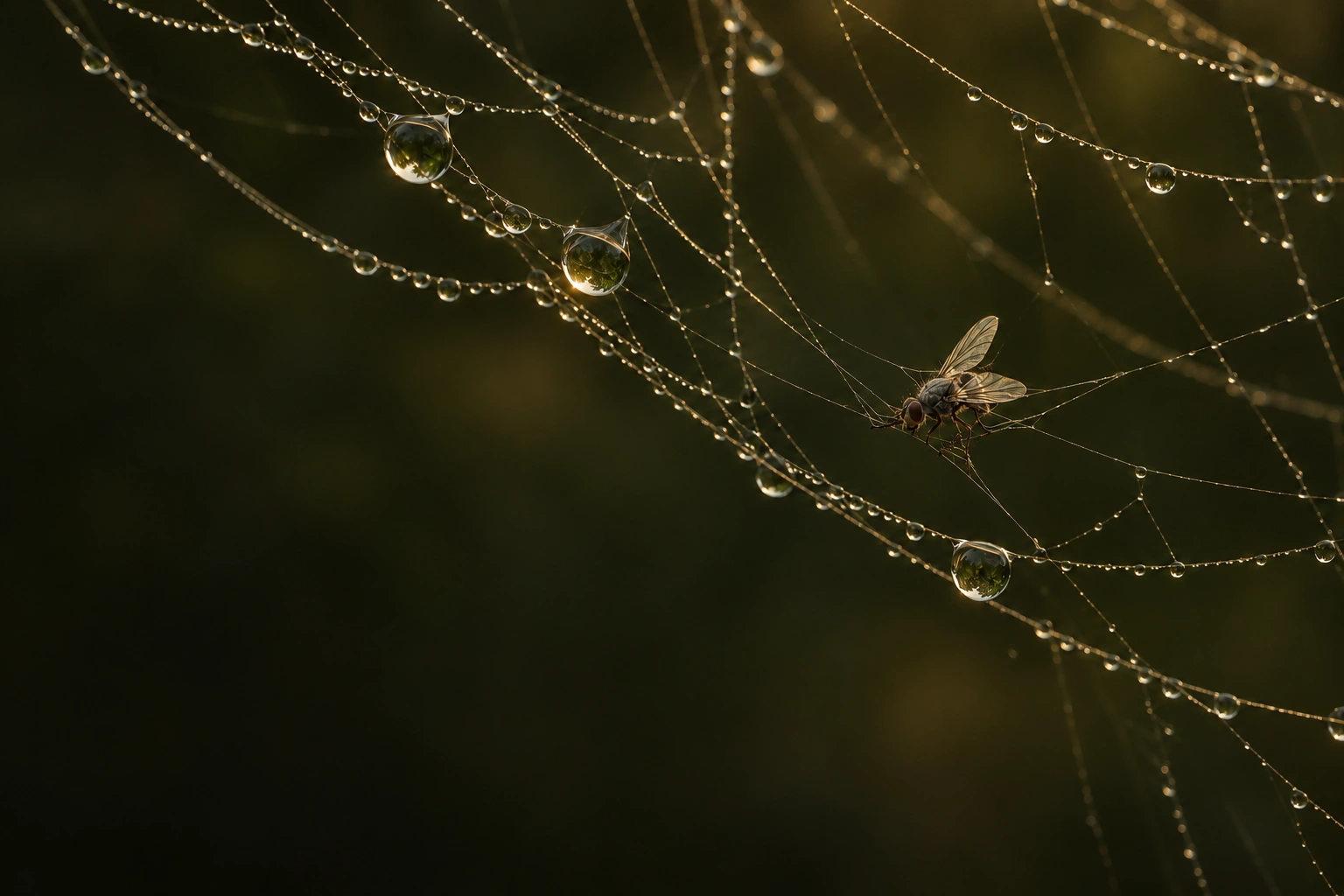
The web was always a trap. The beauty was never imaginary.
The spider didn't build it to frighten you.
It built it to catch something.
A singing bird faces a second bird on a branch across a gap.
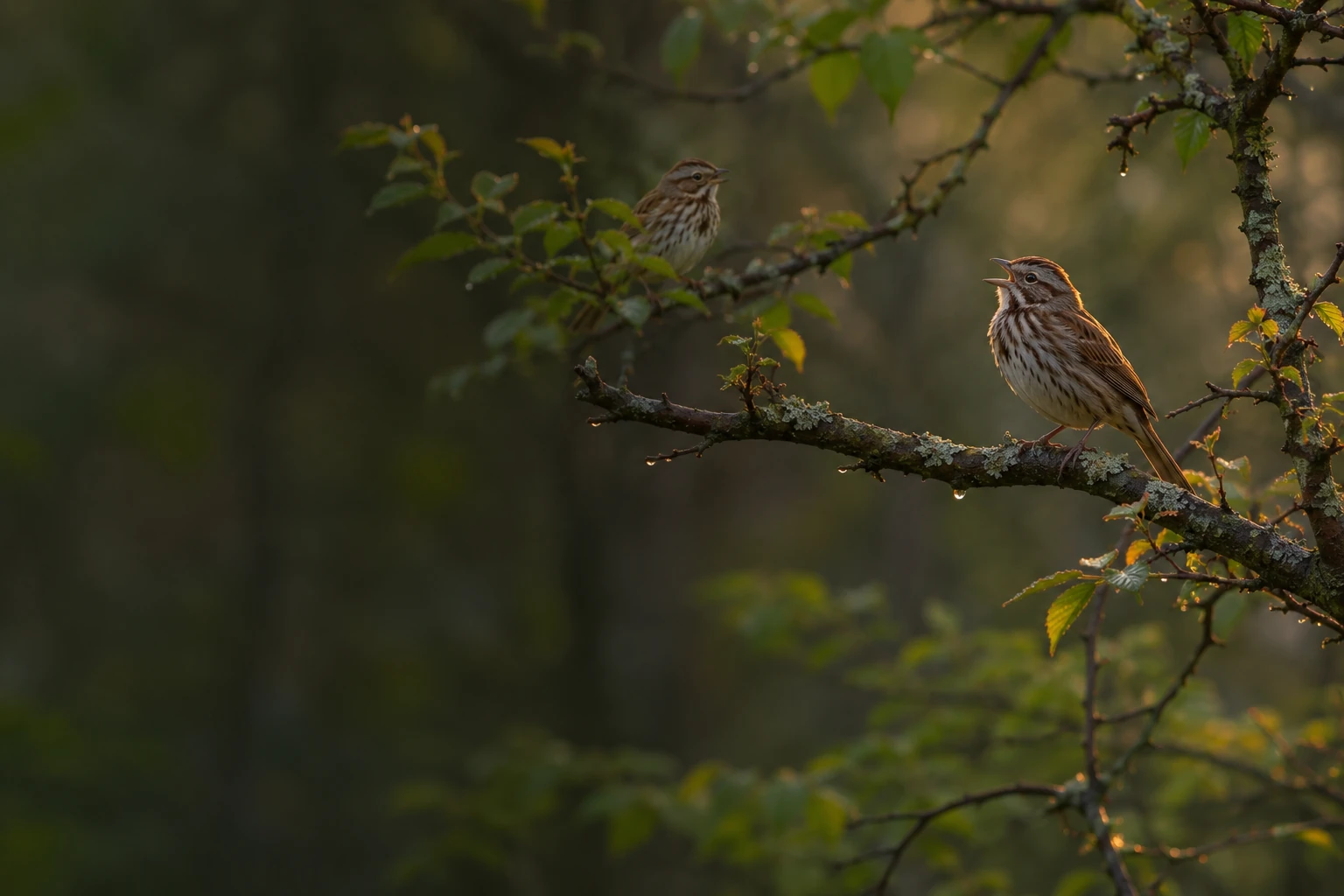
Perhaps you've listened to birds singing at sunrise and felt that the world was welcoming another day.
But some of those beautiful songs are territorial warnings. A declaration of space. A message to rivals.
And those delicate mushrooms appearing after the rain? They're only the visible fruiting bodies of fungi whose hidden filaments may already be breaking down the fallen wood beneath them.
Different lives. Different needs.
Seeking nourishment. Defending territory. Reproducing. Surviving.
Nothing was pretending.
The spider wasn't trying to deceive you. The birds weren't singing for your comfort. The fungi weren't growing for your admiration.
You supplied the meaning yourself.
The web is still sparkling.
The birds are still singing.
The mushrooms are still growing.
Nothing has changed.
A mosquito rests on a twig beside the edge of a person's sleeve and bare arm.
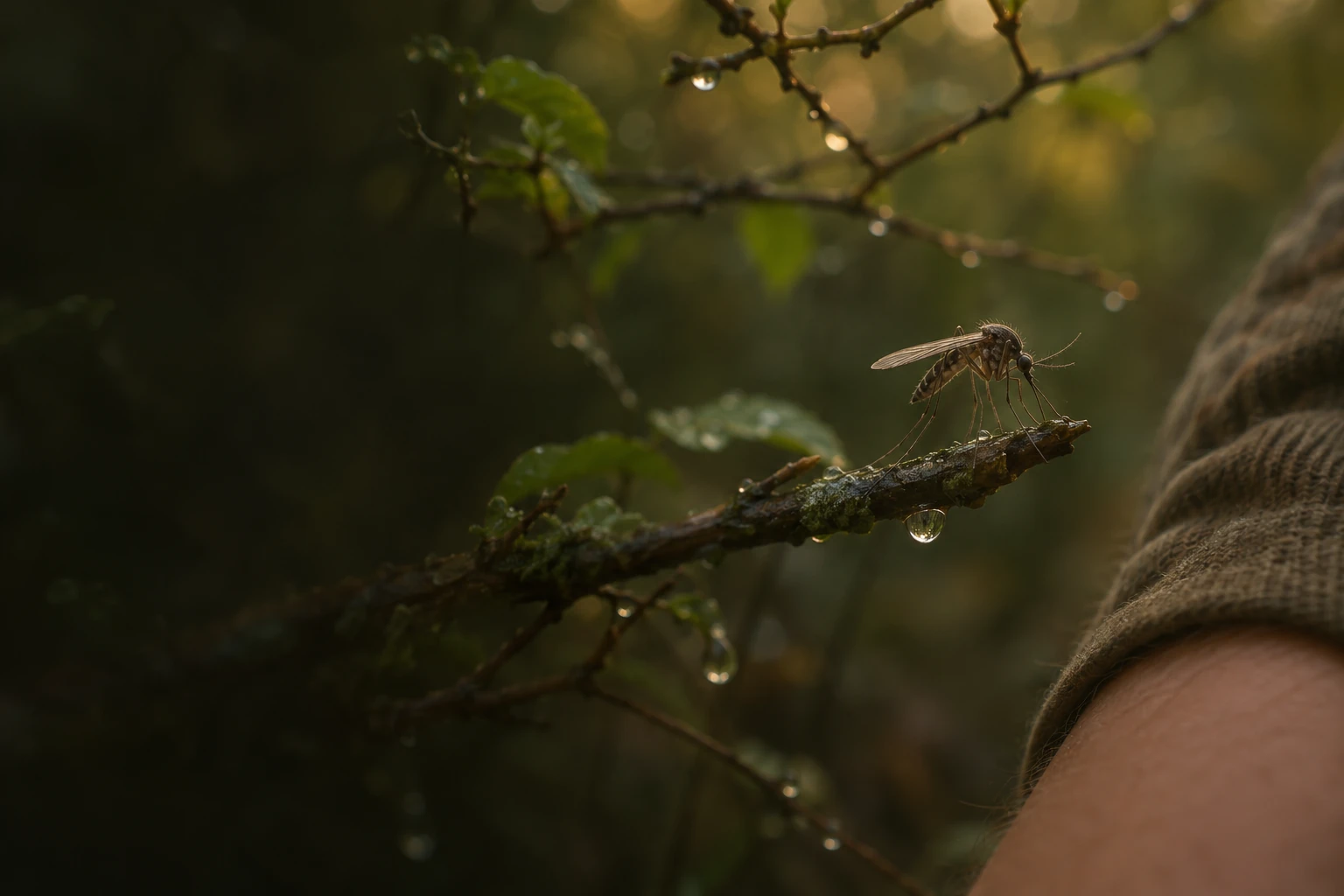
And somewhere in that same beautiful morning, something may already have detected your presence.
Not because it knows who you are.
But because you are something it has been waiting for.
You might imagine that walking away would restore some distance.
But where, exactly, would you go?
Step beneath the trees, and the forest surrounds you. The air carries the scent of damp soil and decaying leaves. Beneath your feet, roots and fungal filaments thread through the earth. Above you, insects move through the branches, responding to signals you cannot see.
You hear birdsong.
Something else detects movement.
You smell the rain.
Something else follows a chemical trace.
You feel the warmth of sunlight against your skin.
And somewhere nearby, that warmth may mean something entirely different.
The same forest. The same moment.
But not the same world.
The biologist Jakob von Uexküll called this an Umwelt: the perceptual world an organism inhabits, shaped by what it can sense and how it can respond.
A mosquito does not need to recognize your face. Carbon dioxide from your breath, the warmth of your skin, and the chemistry of your body can be enough to guide it toward you.
You may never notice the moment you become detectable.
To something else, you are already part of the landscape.
The forest has no single pair of eyes. No central mind directing its inhabitants. Yet everywhere, living things respond to other living things.
Some seeking nourishment. Some avoiding danger. Some competing for space. Others sustaining one another.
None needs to understand the whole.
And none of it requires your awareness.
You came to admire the forest.
But the forest was never merely scenery.
Shelf fungi, white filaments, a woodlouse, and a seedling share a fallen log.
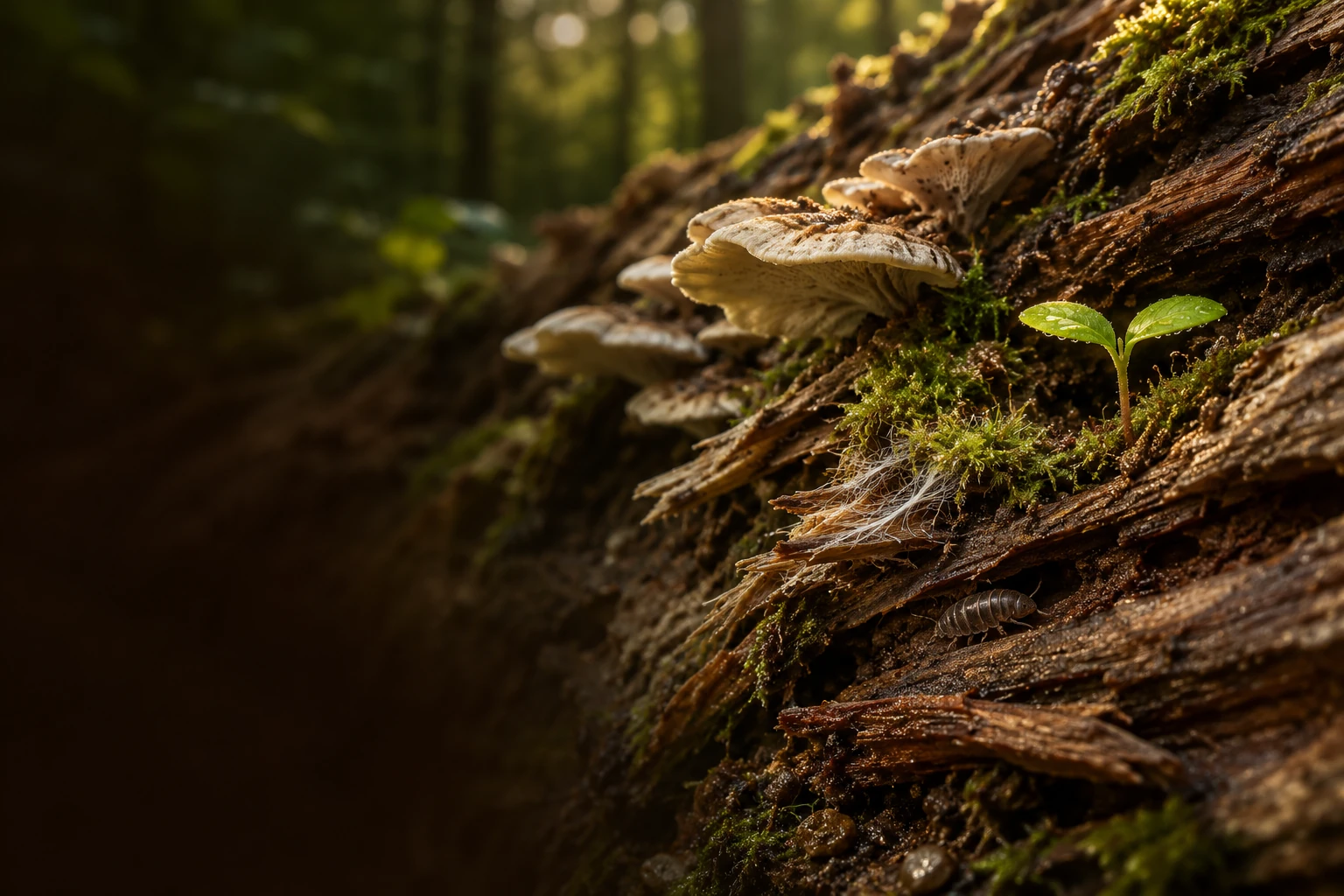
There is a peculiar comfort in believing that danger has an intention.
Something to recognize. Something to avoid. Perhaps even something to reason with.
But what happens when there is no one making the decision?
Consider the fallen tree beneath those mushrooms.
To you, it may seem like something the forest has lost. To the fungi growing through its wood, it is a source of nourishment. To insects, a habitat. To seedlings, perhaps the very place where new roots will take hold.
The same decay that dismantles one living structure can create opportunities for countless others.
In complex-systems biology, such patterns can emerge through interactions among organisms responding to local conditions. Fungi release enzymes that break down organic material. Nutrients move through soil and living tissues. Other organisms respond to the changing availability of resources.
There is no central coordinator deciding what should live, what should die, or what should grow in its place.
Yet the relationships continue.
The forest does not have to be failing for something within it to be dying.
Nor does it have to be cruel for something within it to be consumed.
The mushrooms continue to grow. The fallen tree continues to decompose. Somewhere nearby, a seedling takes root.
The forest does not love us.
The forest does not hate us.
It does not have to.
Electric blue speckles trace the disturbed lip of a wave as it breaks in the dark.
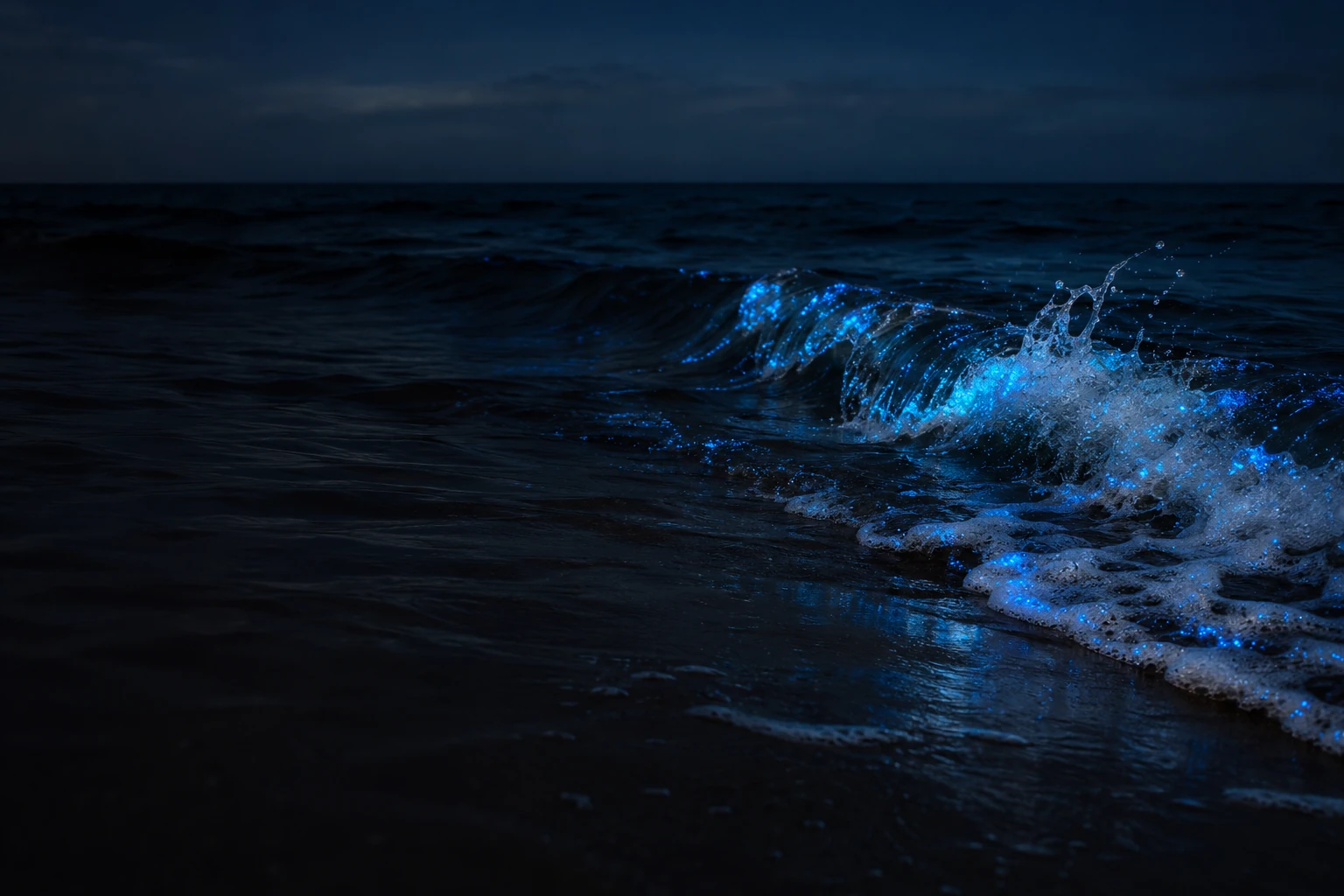
And yet, knowing all this, would you find the world any less beautiful?
Imagine standing at the edge of the ocean after dark.
The waves begin to glow. Electric-blue light curls through the water, illuminating each disturbance before fading into darkness.
You might reach toward it, enchanted by the way the sea seems to respond to your touch.
And in a sense, it does.
Some microscopic marine organisms, called dinoflagellates, produce flashes of light when disturbed. In certain species, these flashes help defend against organisms that feed on them.
But researchers discovered something stranger.
When tiny grazing crustaceans called copepods encountered flashing dinoflagellates, they made sudden escape movements. Those movements disturbed the surrounding water, making the grazers easier for another predator to detect.
The flash that helped one organism avoid being eaten could expose its attacker to another hunter.
What looks like an invitation to us may be an alarm in another organism's world.
One organism flashes. Another reacts. A third responds.
A tiny disturbance travels through an ecological relationship, changing what happens next.
The ocean was never illuminating itself for our admiration.
And still, the light is beautiful.
The opening web returns with its luminous dew and the trapped fly visible together.
Tomorrow morning, the birds will sing again.
The mushrooms will continue their quiet work beneath the trees. Somewhere, a spider will wait beside a web that catches the sunlight.
You may find it all just as beautiful as before.
And perhaps you should.
But now, when you look at the world, you might remember that you are not the only living thing interpreting what surrounds it.
You are not the only one responding.
And you were never standing outside the relationships you came to admire.
The world has not changed.
But perhaps the next time you stop to admire something beautiful, you'll wonder what it sees in you.